poqui Get the app

Audio tour guide for iPhonePress once. Hear the story of where you stand.

poqui tells you the story of the exact spot you’re standing in: the square, the street, the building on the corner. About ninety seconds, read aloud in a warm voice, written from real sources. Then it shows you something to look for.

Download on the App Store
Hear an example story 2:24

Free to downloadNo accountWorks in any town

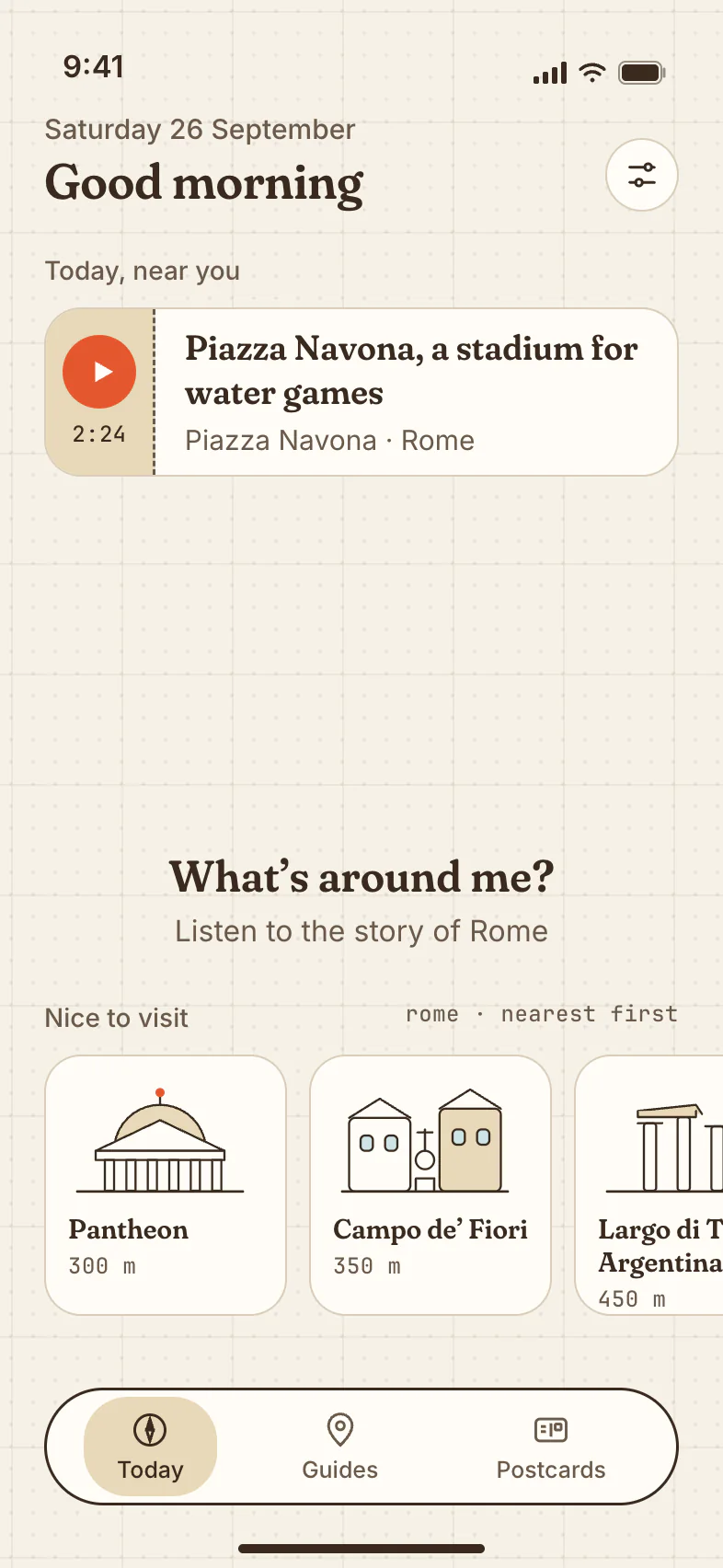
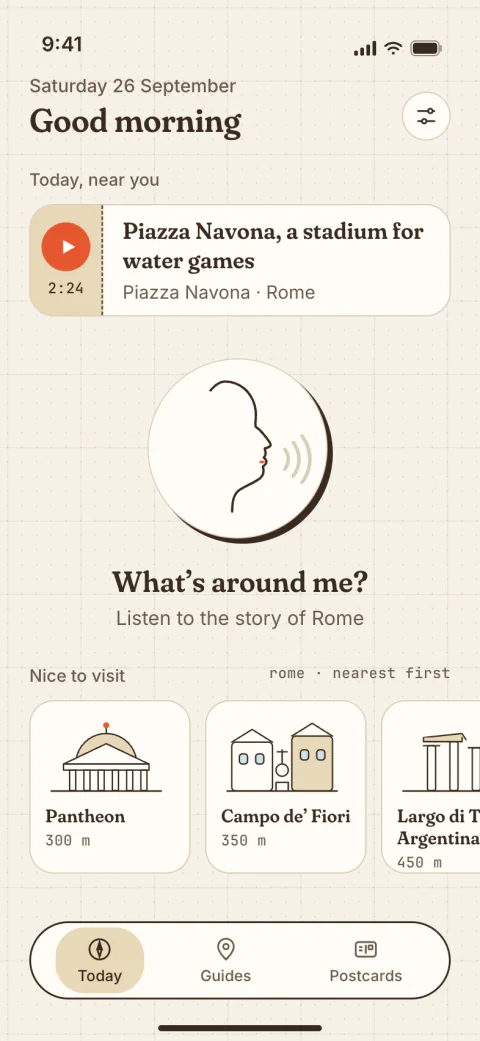
The poqui app on iPhone: Today in Rome, with the morning story “Piazza Navona, a stadium for water games”, the talking-face button “What’s around me?” and nearby places to visit

Example story

Hear an example before you download.

This is one real story from the app, exactly as poqui tells it when you stand in Piazza Navona, Rome, read by Sofia, one of its two voices. In the app you press the same button anywhere, and hear the story of wherever you are.

  • 2:24 long
  • A real story from the app
  • Sources included

Press to listen

Piazza Navona, a stadium for water games

Ready when you are0:00 / 2:24

The transcript opens while it plays.

Piazza Navona, a stadium for water games

Piazza Navona in Rome has the shape of an ancient stadium, because that is what it was. Emperor Domitian had it built in the eighties, between 85 and 86 AD, to host athletic competitions. It was the first masonry stadium in the Greco-Roman world.

The stadium was long and narrow, with one semicircular end, and could hold about thirty thousand spectators. Domitian loved Greek athletic games, but the Roman people found them neither manly nor violent enough. The stadium was restored in the third century and remained in use until the fifth century.

In the mid-seventeenth century, Pope Innocent X commissioned Gian Lorenzo Bernini to design the Fontana dei Quattro Fiumi for the center of the piazza. It portrays the four main rivers of the Earth, one for each continent known at the time: the Danube, the Ganges, the Nile, and the Rio de la Plata. To fund the fountain, the Pope taxed bread, which reduced the standard weight of a loaf. This made the people of Rome hate his sister-in-law, Olimpia Maidalchini, whom they blamed for the indignity. The fountain is still there, and the loaf is still smaller. Some decisions have a long shelf life.

The piazza was originally called “in Agone,” from the Latin for “games.” Later, it became known for its water games. The three fountains in the piazza could be blocked, allowing the square to flood. This was done for public amusement until the late nineteenth century.

Tip: tap any sentence to jump to it. In the app, the story keeps playing with your iPhone locked.

✓ From the sources

Written from Wikipedia’s articles on Piazza Navona, the Stadium of Domitian, the Fountain of the Four Rivers and the Agonalis Obelisk (Italian edition, CC BY-SA). Every poqui story lists its sources like this.
How the audio guide works

No map. No route. Just a button.

A self-guided audio tour, one stop long, wherever you happen to be. Three steps, and the third one is looking up.

  1. poqui’s Today screen with the talking-face button: “What’s around me? Listen to the story of Rome”

    1Press

    Open poqui and press the face. Or don’t even open it: the Action Button, Back Tap and Siri (“poqui, what’s here?”) work too.

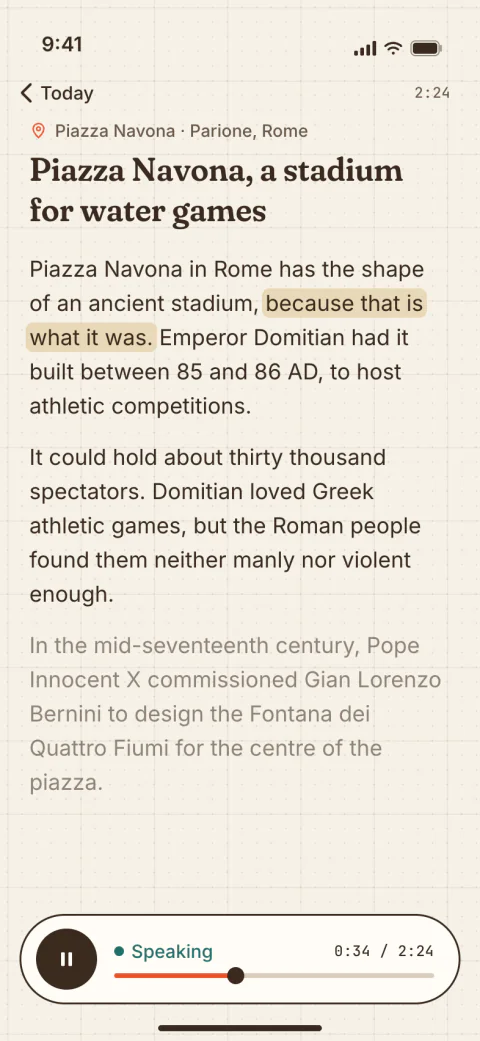
  2. A poqui story playing: “Piazza Navona, a stadium for water games”, with the sentence being read highlighted

    2Listen

    In a few seconds, a natural voice tells you the story of exactly where you stand: why the street has that name, what the corner building replaced, what happened in this square centuries ago.

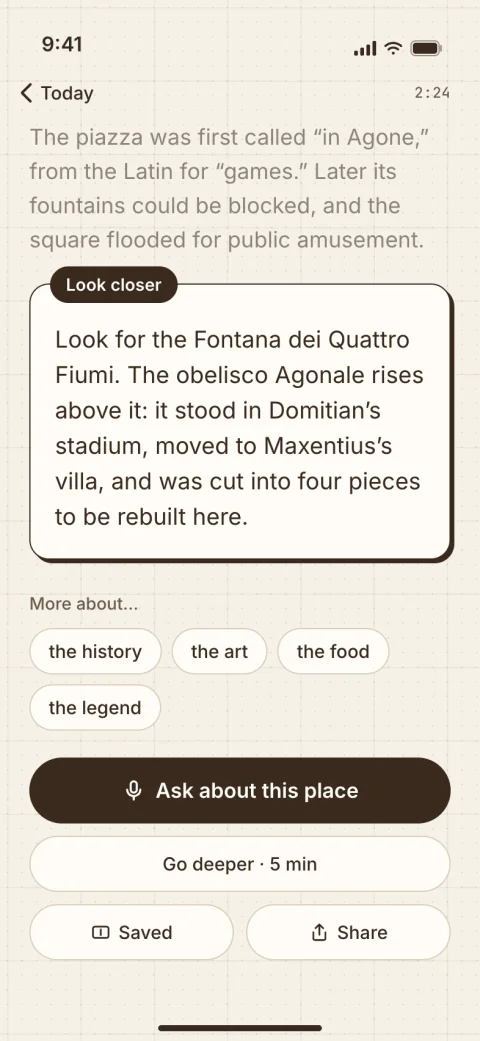
  3. The end of a poqui story: a “Look closer” card pointing at the obelisk above the Fountain of the Four Rivers, with buttons to ask a question or go deeper

    3Look closer

    Every story ends on something you can see from where you’re standing. Then it stops. Ask a question, go deeper, or walk on.

Try it on your next walk.

Free to download, your first three stories free, no account.

Download on the App Store
Real history, real sources

Real history, read aloud.

poqui writes each story from what has actually been written about the place (mostly Wikipedia, read in the local language as well as in English) and lists its sources under every story. Legends are labelled as legends. And where a spot has little on record, poqui says so instead of making something up.

  • Sources under every story, one tap away
  • Facts and local lore marked differently
  • Spot a mistake? Report it from the story
The poqui story player reading the history of Piazza Navona aloud, with the place line “Piazza Navona · Parione, Rome”
Curious? Ask.

Ask it anything.

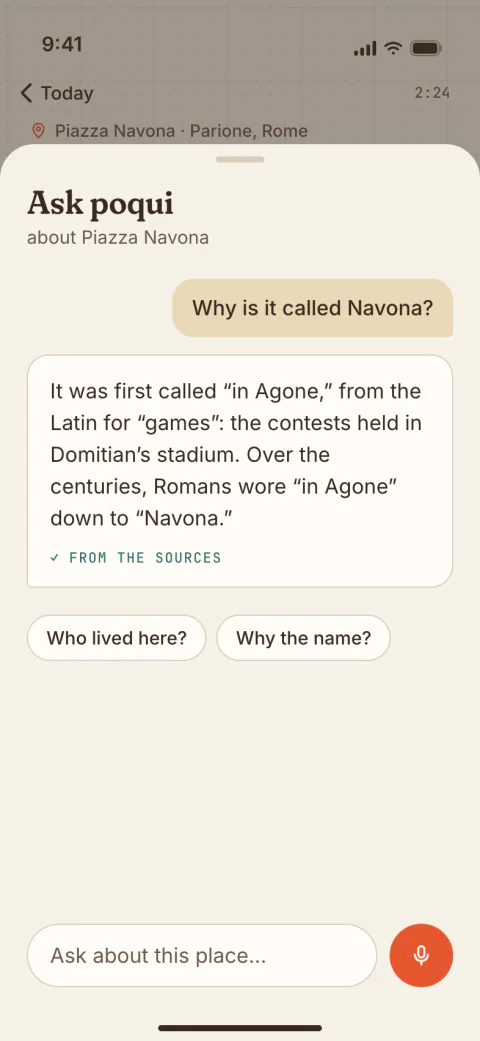
After a story, ask a follow-up, typed or out loud. poqui answers from the same sources, and tells you when it doesn’t know. iOS turns your voice into text, and poqui only ever receives the text.

Why is it called Navona?Who lived here?What was here before?
Ask poqui: “Why is it called Navona?” answered from the sources: it was first called “in Agone”, from the Latin for games
Audio city guides, on request

Any city. A guide in a minute.

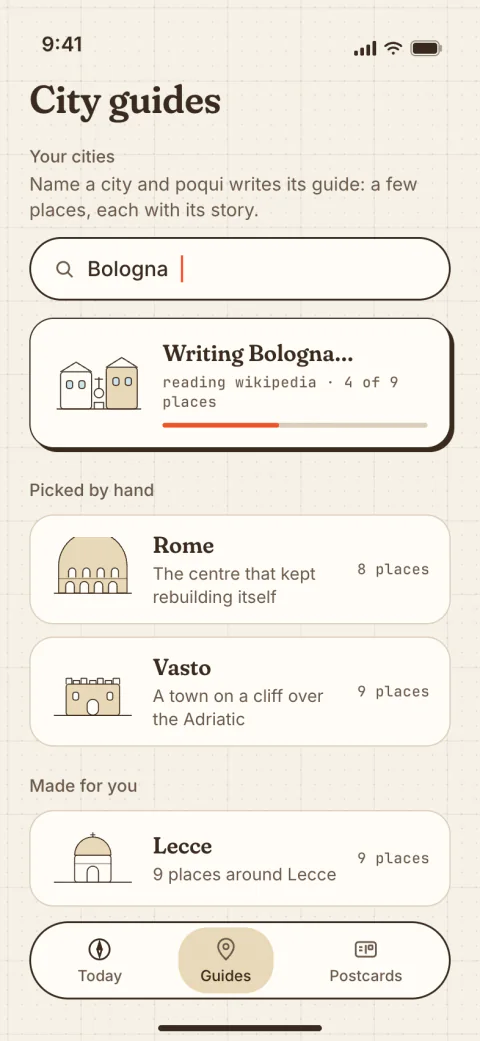
Going somewhere? Type a city and poqui writes its audio guide while you wait: an introduction, then the places worth hearing, nearest first. Hand-picked guides come ready too, starting with Rome.

  • Bologna, Lisbon, your grandmother’s village: any town works
  • Each place has its own story, ready to play on the spot
  • Plan at home, or press when you get there
poqui’s City guides screen: typing “Bologna” while poqui writes its audio guide, with the hand-picked Rome guide below
Features

Small things, done properly.

Your street has a story too.

One morning story about wherever you wake up, at the hour you choose. One notification a day, never more.

Your morning story nowThis morning: a story from around Rome.

The world has a button.

Put “What’s here?” on the Action Button or Back Tap, or ask Siri: “poqui, what’s here?” Press it anywhere; poqui does the rest.

Action ButtoniPhone 15 Pro and later
Back TapDouble-tap the back of your iPhone
Siri“poqui, what’s here?”

Collect towns, not streaks.

Every story you hear becomes a postcard: the title, the town, a line worth keeping. Send one to someone who lives there.

rome, parione · 26 sepPiazza Navona, a stadium for water games
rome, sant’eustachio · 25 sepPiazza della Rotonda, cleared for a dome

Keeps talking in your pocket.

Lock your iPhone and walk on. The story keeps playing, with controls on the lock screen, and pauses for a call.

Campo de’ Fiori, where a philosopher burnedpoqui · rome

Two warm voices.

Sofia, calm and unhurried, or Luca, lower and steady. Both are free: pick the one you like, and change it whenever you want.

SofiaA calm woman, unhurried.default
LucaA man, lower and steady.also free

No account. No ads. No tracking.

Nothing to sign up for. Your location is used to find the story, never to follow you, and your history and postcards stay on your phone. Every permission is optional, and poqui works without each one.

LocationUsed for the story, never tracked.
MicrophoneOnly to ask a question out loud.
NotificationsOne story each morning, never more.
poqui vs. the classic audio tour

Not a tour. A button.

Audio tours are wonderful when you have three hours and a route. poqui is for all the other moments: sightseeing without a plan, waiting for a friend, walking home, standing somewhere and wondering.

How poqui compares with a classic audio tour
QuestionA classic audio tourpoqui
Where it worksFamous sights, along a set routeWherever you are: a city, a town, a village street
How it startsFollow the route, or let GPS talk in your pocketYou press. It tells. It stops.
How longOne to three hoursAbout ninety seconds, five-minute chapters if you want more
Where the facts come fromRarely saidListed under every story; legends labelled as legends
QuestionsNot reallyAsk anything, typed or out loud
Sign-upOften an accountNone, ever
Pricing

Free to start. Plus if you’re hooked.

Free

$0to start

  • Your first 3 stories
  • Questions and postcards
  • Both voices, Sofia and Luca
  • No account

poqui Plus

$9.99a month

or $69.99 a year · cancel anytime

  • Up to 40 new stories a month (300 a year)
  • Every city guide, ready-made or written for you
  • Ten new cities a day
  • Go deeper: five-minute stories

Prices in US dollars, as on the US App Store; elsewhere the App Store charges in your local currency (in Italy, €9.99 a month or €79.99 a year). Plus renews until you cancel it in your Apple Account settings. There is no free trial: your first three stories are the free part. Full terms of use.

Download on the App Store
Questions

Good questions.

Anything else? Write to hello@poqui.app. A person answers.

What is poqui?

poqui is an audio tour guide for iPhone that tells you the story of exactly where you are. Press one button and a natural voice tells you about ninety seconds of history about the street, square or building around you, written from real sources (mostly Wikipedia). Then it points out something you can see from where you’re standing.

Does poqui work in my town?

Almost certainly. poqui works in cities, towns and villages anywhere in the world, as long as something has been written about the place: not only famous landmarks and historic sites, but ordinary streets and village squares too. Where there is very little on record, it tells you so honestly instead of inventing a story.

Is poqui an AI tour guide? Can I trust the stories?

Each story is written by AI, from public sources and only from them: when you press, poqui looks up what has been written about the places within a short walk of you, in Wikipedia’s local-language edition and in English. The sources are listed under every story, local legends are labelled as lore, and if something is wrong you can report it from the story in one tap. Before the first story, the app asks your agreement to send the place’s name to the AI, and you can withdraw it any time in Settings.

Is poqui free?

Yes, to start. poqui is free to download, and your first three stories are free, with both voices, questions and postcards. After that, poqui Plus gives you up to 40 new stories a month, opens every city guide and adds the Go deeper stories, for $9.99 a month in the US (€9.99 in Italy), or $69.99 a year (€79.99 in Italy). There is no free trial. Cancel anytime.

Do I need an account? What happens to my location?

No account and no sign-up: no email, no password, no login. The only personal detail poqui asks for is a first name for its greeting, which you can skip and which stays on your phone. No ads and no tracking either. Your location is sent only when you ask for a story (and for the morning story, if you turn it on), to find the sources around you; it isn’t kept. Rather not share it? Explore any place by name instead. The details are in the privacy policy.

Does it keep playing with the screen locked?

Yes. Lock your iPhone and the story keeps playing, with controls on the lock screen and in your headphones. It pauses for calls. poqui needs an internet connection to fetch a new story.

Is poqui available on Android?

Not yet, but it’s coming soon. For now poqui is for iPhone and needs iOS 17 or later.

When can I download poqui?

Right now: poqui is on the App Store, free for iPhone, and an Android version is on its way. Or listen to an example story right here first.

Free to download

The most ordinary street you know isn’t.

Get poqui free for iPhone on the App Store. The Android version is coming soon.

Download on the App Store
Hear an example story first